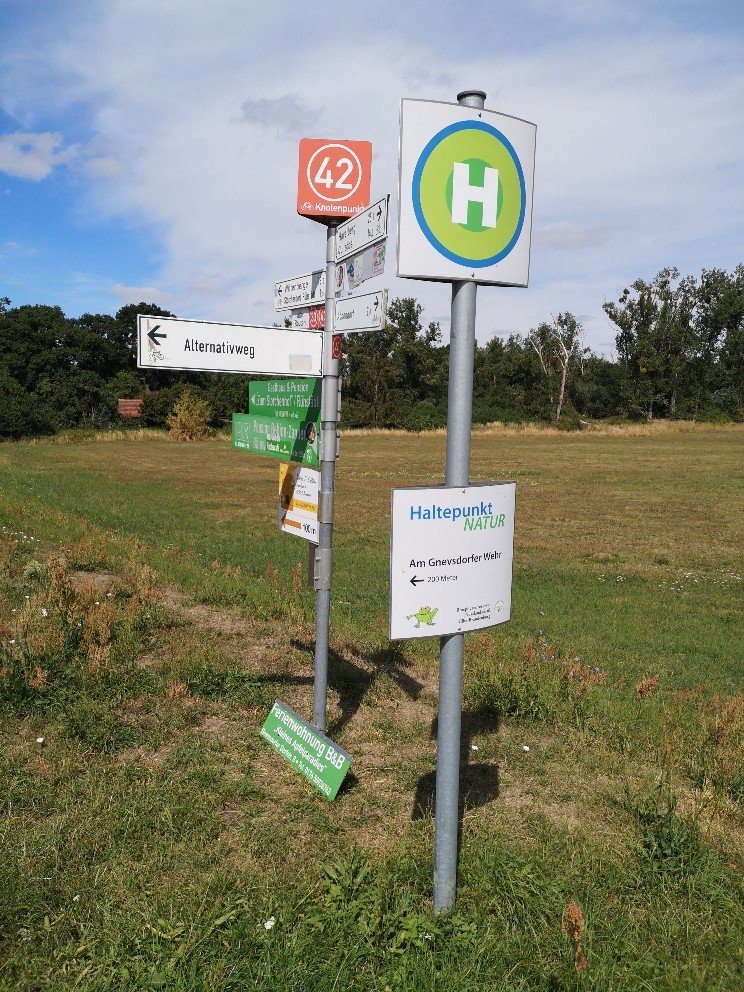
Es geht voran. Am Tag 3 der Expedition Elberadweg ist der Rhythmus gefunden. Die Gliedmaßen wissen, was zu tun ist. Die Augen haben zu tun. Der Kopf auch. Nach Durchquerung der Hansestadt Havelberg fand ich mich auf dem Elberadweg rechts der Elbe wieder, sah diese aber erst nach ca 15 km wieder. Havelberg liegt wie der Name schon sagt an der Havel, nicht an der Elbe. Dort schaute ich mir den Dom und den dazugehörigen Garten an, ließ mich vom Gärtner nochmal abduschen, tankte Fahrrad mit Luft und los ging es durch Wald und Wiesen entlang der Havel. An der Wehranlage Quitzöbel kam ich vom Elberadweg ab. Dort wurde gerade fleißig gebaut und ich landete auf einer Umleitung, die parallel zum Elberadweg verlief, allerdings nicht an der Elbe sondern entlang einem Vorfluter. Traumhaftes Wetter. Nicht für die Landwirtschaft, ich weiß. Ich traute mich auch nicht,vom Weg herunterzufahren. Überall in Europa wüten Waldbrände. Ein Wunder, dass hier noch nichts passiert ist. Ich überschritt die Landesgrenze nach Brandenburg. Und es ist schon auffällig, wie unterschiedlich die einzelnen Bundesländer entlang des Elberadwegs diesen unterhalten. In Brandenburg findet man diverse Naturhaltestellen entlang des Wegs. Das sind kleine Rastplätze, die neben Schutzhütten oder Aussichtstürmen auch Informationen zu Flora und Fauna entlang des Flusses geben.
Things are moving forward. On day 3 of the Expedition Elberadweg, the rhythm is found. The limbs know what to do. The eyes are busy. The head too. After crossing the Hanseatic town of Havelberg, I found myself on the Elbe cycle path to the right of the Elbe, but didn’t see it again for about 15 km. As the name suggests, Havelberg is on the Havel, not the Elbe. There I took a look at the cathedral and its garden, had the gardener give me another shower, filled up my bike with air and off I went through woods and meadows along the Havel. I left the Elbe cycle path at the Quitzöbel weir. Construction work was going on there and I ended up on a diversion that ran parallel to the Elbe cycle path, not along the Elbe but along a receiving watercourse. Fantastic weather. Not for agriculture, I know. I didn’t dare leave the path either. Forest fires are raging all over Europe. It’s a miracle that nothing has happened here yet. I crossed the border into Brandenburg. And it is striking how differently the individual federal states along the Elbe cycle path maintain it. In Brandenburg, there are various nature stops along the way. These are small rest areas that, in addition to shelters or lookout towers, also provide information on the flora and fauna along the river.


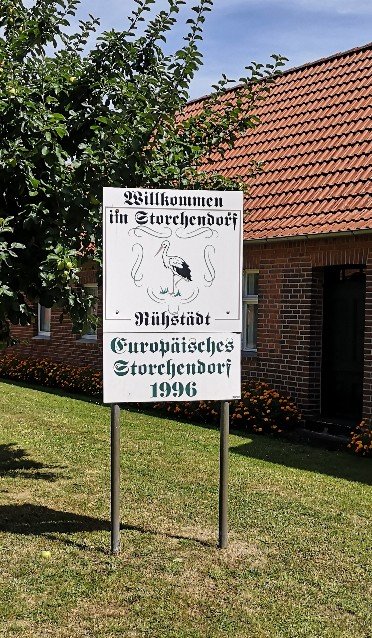
Wieder an der Elbe angekommen, durchquerte ich das Dörfchen Rühstädt. Storchendorf im Jahre 1996. Und die Störche sind auch 2022 zahlreich erschienen. Es gibt allein in diesem Dorf über 20 Nester. In diesem Jahr zählt man 86 Junge. Also die menschliche Geburtenrate in Deutschland steigt nicht an, dafür die der Störche. Wahrscheinlich gibt es noch zu viele Menschen, die an den Klapperstorch glauben. Haha. Das ganze Dorf hat sich dem Storch verschrieben. Ein Besucherzentrum, ein Storchenhaus (ohne Hebamme, denn so heißen die Geburtshäuser in Berlin). Kein Gasthaus, was erfrischende Getränke anbietet. Das einzige Café hatte Ruhetag und das Hotel scheint Corona nicht überlebt zu haben. So breitete ich meine Yogamatte auf einem Fahrradrastplatz aus und machte mich an meine Vorräte, die ich während der Fahrt gesammelt habe: Brombeeren, Kornäpfel … Noch 2 Wochen später dann kann man die vielen Zwetschgen und Birnen ernten.
Back on the Elbe, I crossed the village of Rühstädt. Stork village in 1996. And the storks are still numerous in 2022. There are over 20 nests in this village alone. This year they counted 86 young. So the human birth rate in Germany is not increasing, but that of the storks is. There are probably still too many people who believe in the stork. Haha. The whole village is dedicated to the stork. A visitor centre, a stork house (without a midwife, because that’s what birth houses are called in Berlin). No inn offering refreshing drinks. The only café was closed and the hotel seems not to have survived Corona. So I spread out my yoga mat on a bicycle rest area and set to work on the supplies I’d collected during the ride: Blackberries, corn apples … Another 2 weeks later, you can harvest the many plums and pears.


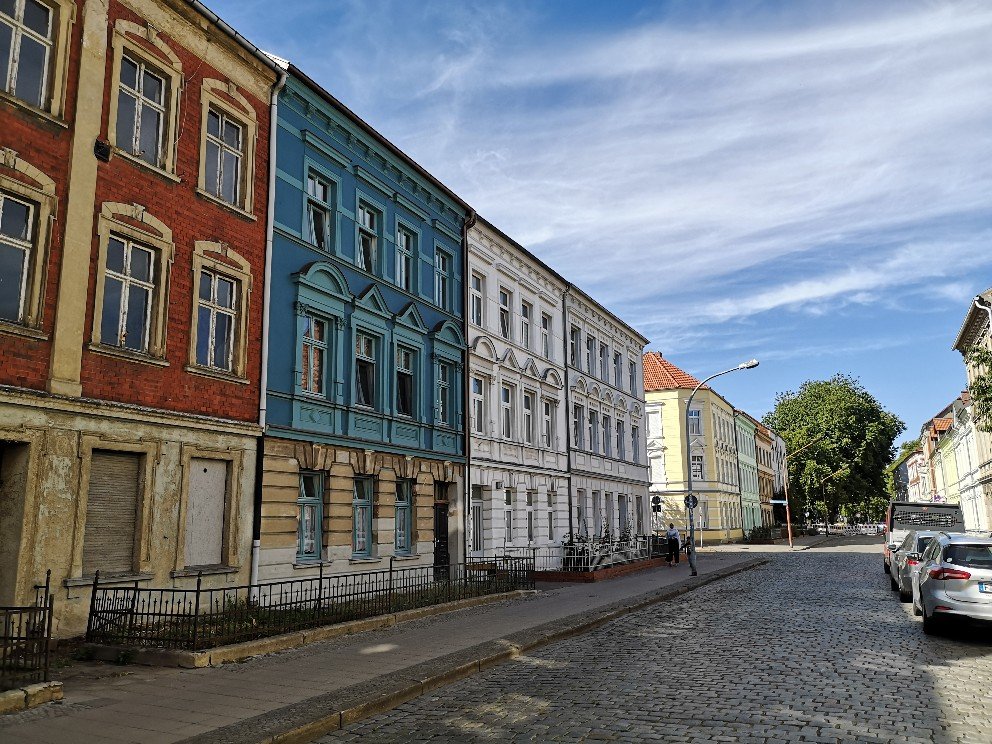
Die verbleibenden 12 km verliefen größtenteils über dem Deich. Schon recht früh am Nachmittag erreichte ich die ehemalige Industriestadt Wittenberge, wo ich in der Pension zum Tivoli eine Hütte bezog. Wittenberge ist bekannt durch die Singer – Nähmaschinenwerke, die Isaac Singer hier zu Beginn des 20. Jahrhunderts gründete. Von weitem sieht man den berühmten Uhrenturm. Das Ziffernblatt soll wohl eins der größten in Europa sein. Ist sogar größer als das vom Big Ben. Entlang des Hafens hat man die Backsteingebäude (Speicher, Hafengebäude, alte Mühle) rekonstruiert. Eine echte Flaniermeile. Nur in der Innenstadt fehlt es noch an Investitionen. Die einst prächtigen klassizistischen Wohnhäuser stehen zum großen Teil leer und sind sich selbst überlassen.
The remaining 12 km were mostly over the dyke. Quite early in the afternoon I reached the former industrial town of Wittenberge, where I moved into a cabin at the Pension zum Tivoli. Wittenberge is famous for the Singer sewing machine factory, which Isaac Singer founded here at the beginning of the 20th century. From far away you can see the famous clock tower. The clock face is said to be one of the largest in Europe. It’s even bigger than Big Ben’s. Along the harbour, the brick buildings (warehouses, harbour buildings, old mill) have been reconstructed. A real promenade. Only the city centre still lacks investment. The once magnificent neoclassical residential buildings are largely empty and left to their own devices.




Fazit des heutigen Tages: 44 km in 5h30. Morgen Ruhetag? Wer mich kennt, weiß, dass ich das nicht kann.
Conclusion of today: 44 km in 5h30. Rest day tomorrow? Anyone who knows me knows that I can’t do that.
 Reisen und Socken - Socken und Reisen
Hinterlasse einen Kommentar